Incentivizing photovoltaic panel cleaning in green building standards
A Policy Framework
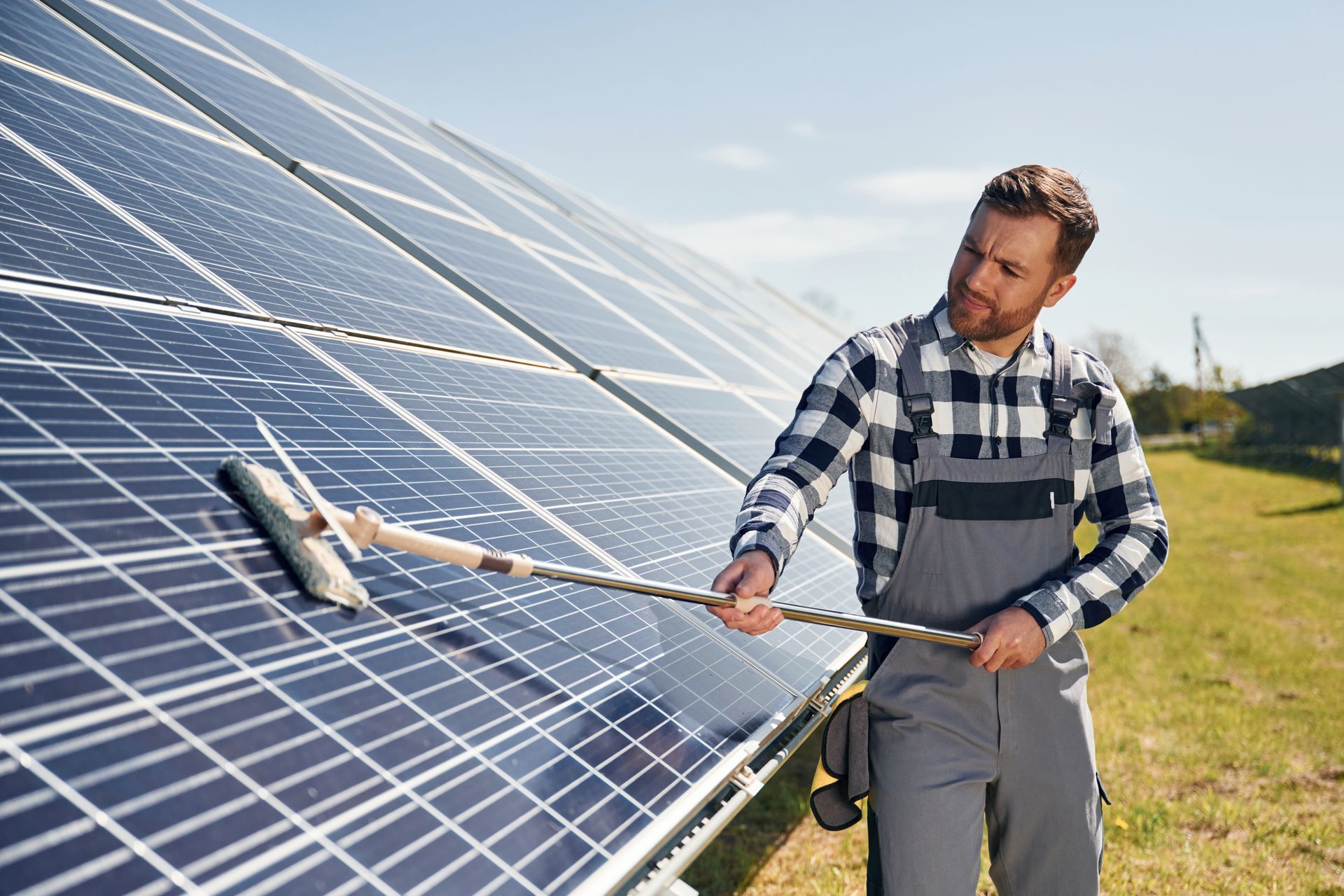
In the built environment (BE), green building rating systems (GBRSs) serve as effective policy tools for promoting and ensuring sustainability across various aspects, including energy. These systems already reward the incorporation of renewable energy technologies, which are foundational to sustainable practices. Among these technologies, photovoltaic (PV) panels are widely integrated into the BE in various configurations. However, their performance is significantly impacted by environmental factors such as soiling, which can drastically reduce their efficiency. This work introduces a proposed policy framework within GBRSs to award points for the cleaning of PV panels. This “PV Cleaning and Maintenance Credit” introduces an innovative approach to elevate the role of renewable energy systems in GBRSs by emphasizing regular, sustainable maintenance. By guaranteeing optimal energy generation, this credit not only enhances the energy efficiency in green buildings but also addresses a critical gap in existing rating systems. Nonetheless, implementing such a credit presents challenges, including water usage concerns and cost implications. Overcoming these obstacles will be essential to fully realizing the potential of this proposed improvement to GBRSs.
Graphical abstract
Introduction
Today, the world increasingly recognizes the critical importance of sustainability. Governments worldwide demonstrated their commitment to this issue through significant initiatives, such as signing agreements like the Paris Agreement, organizing conventions like the COP under the UNFCCC umbrella (UNFCCC, 2024), and creating financial mechanisms like the Green Climate Fund to promote sustainability (Green Climate Fund, 2024). Additionally, global strategies, such as the Sustainable Development Goals (SDGs), further emphasize the need for comprehensive and actionable measures to address sustainability challenges (THE 17 GOALS | Sustainable Development, 2015).
Energy is a key focus area in sustainability initiatives. Sustainable energy involves production, distribution, and consumption in ways that fulfill present demands while preserving the resources and capabilities needed for future generations to meet their needs (Isabelle dos Santos et al., 2024). This concept has become a trending topic in research and development, attracting significant attention and boosting the visibility of related studies (Moustakas et al., 2020). Moreover, major energy corporations, such as TotalEnergies (TotalEnergies, 2024) and QatarEnergy (QatarEnergy, 2024), have undergone rebranding to signal their commitment to diversifying portfolios beyond oil and gas and embracing renewable solutions, an ambitious effort to keep pace with sustainable energy requirements.
Renewable energy plays a pivotal role in meeting sustainability targets, although related technologies vary in their maturity and readiness for widespread deployment (Østergaard et al., 2022). Resources such as solar, wind, and hydropower play a vital role in the global shift toward sustainable energy (Ang et al., 2022) and significantly contribute to the goal of reaching net-zero carbon emissions by 2050 (Obobisa, 2022), as advised by the IPCC (IPCC, 2018). Among these, photovoltaic (PV) systems have emerged as a key component in electricity generation. Their versatility spans applications from small residential setups to expansive solar farms, solidifying their importance in the renewable energy sector (Marques Lameirinhas et al., 2022).
However, when exposed to real-world conditions, PV panels often experience performance losses due to soiling, among other factors, which is caused by the accumulation of dust, dirt, snowfall, bird droppings, and other contaminants (Younis & Alhorr, 2021). The primary reason for this power loss is that particles accumulating on the panel surface form a mesh-like layer, scattering solar rays and reducing the amount of light that reaches the PV cells (Younis et al., 2024). A study by Fernández Solas et al. (2025) produced a soiling loss map for Europe, showing an average annual performance loss of 0.9 % due to soiling when rain is considered. In Northern Africa and the Middle East—regions that, along with China and India, are projected to host 60 % of the global installed PV capacity by 2050—dust accumulation reduces panels' capacity factor by as much as 60 % compared to the clean panels (Alkharusi et al., 2024). Furthermore, Wan et al. (2024) comprehensively reviewed the literature to reveal that dust can reduce the PV performance in a varying manner depending on the geographic locations by a loss percentage ranging from 7 % to 98.13 %.
As technologies supporting PV systems are advancing rapidly to match innovations in solar panel materials and performance improvements, cleaning methods are also evolving. For instance, Fan et al. (2022) tested a novel water-free robotic system to clean a 2 kW PV installation on a building's roof. The robot achieved cleaning effectiveness of 92.46 %, resulting in an efficiency increase of 11.06 % to 49.53 % in the PV panels. However, conventional methods, such as manual cleaning with water and natural cleaning through rain, continue to demonstrate superior reliability compared to newer self-cleaning techniques like specialized coatings (Liu et al., 2024). For example, a study by Majeed et al. (2020) used pressurized water to recover 98 % of the performance of a group of monocrystalline and polycrystalline silicon solar panels prepared specifically for experimentation.
The built environment (BE) includes human-made settings essential for daily living, such as homes, neighborhoods, urban areas, and the infrastructure supporting them, including water systems, energy grids, transportation networks, and other facilities (Locke et al., 2023). Within BE, buildings are the largest energy consumers, accounting for 40 % of global annual energy consumption and 36 % of worldwide carbon emissions (Somu et al., 2021). Hence, the concept of green buildings has emerged as a modern approach to achieving sustainable BE, and adjointly the sustainable energy goals. Green buildings are defined as structures designed to promote sustainability through environmentally responsible.
construction practices and by providing a better quality of life (Izam et al., 2022). In response to this modern sustainability need, experts have introduced green building rating systems (GBRS). These systems are tools designed to evaluate the performance of green buildings (Izam et al., 2022). A more detailed definition characterizes GBRSs as voluntary certification systems that assess green building performance by assigning credits and weightings to environmental factors, categorized into distinct groups (Sartori et al., 2021). The primary aim of GBRSs is to extend the lifespan of buildings while promoting sustainability. Prominent GBRS frameworks include LEED, BREEAM, and GSAS (Younis et al., 2025).
In LEED Building Design and Construction (BD + C) version 4.1, the renewable energy credit category offers up to five points across three tiers: on-site renewable energy generation, new off-site renewable energy, and off-site renewable energy (U.S. Green Building Council, 2024). While this credit aligns with Sustainable Development Goal 7, “Affordable and Clean Energy” (SDG7) (Chen et al., 2023), it lacks any allocation for maintenance practices associated with renewable energy systems. Similarly, in BREEAM International New Construction version 6, under the energy category, the issue “Ene 04 Low Carbon Design” offers three credits aimed at maximizing on-site renewable energy generation (BREEAM, 2024). Yet, this rating system also overlooks the cleaning or general maintenance of PV systems and other renewable energy installations.
Building on the points discussed so far, it becomes clear that current GBRSs do not account for maintenance practices such as the periodic cleaning of PV systems installed in the BE, whether building-integrated or building-applied PV systems (BIPV or BAPV), even though they reward their installation. The blunt reality is that PV systems lose efficiency due to the accumulation of dust, dirt, and other pollutants on the panels. Cleaning, which can be costly, significantly impacts the overall cost-effectiveness and practicality of these systems. To address this gap, this research proposes a framework for introducing PV cleaning credits into GBRSs. This framework would evaluate buildings equipped with PV panels that follow a regular cleaning schedule. By integrating the widely studied issue of PV soiling into a standardized evaluation system, this approach would help mitigate its effects. Furthermore, this framework would shift the focus from theoretical discussions to practical, real-world solutions, providing clear and actionable guidelines for implementation.
It is important to note that operation and maintenance (O&M) requirements differ among renewable energy technologies. This paper presents a credit specifically designed for PV systems, reflecting their unique O&M needs. While the broader concept may be relevant to other technologies, implementation must be adapted accordingly.
The remainder of this article is structured as follows: Photovoltaics in the built environment section provides an overview of PV integration within the BE. Proposed framework for cleaning credits section introduces the proposed framework for PV cleaning credits. Policy implications and discussion section explores the implications of this proposed update, and Conclusion section concludes.